
Photo by 2H Media
Operations is the second of two pillars of our system. The first pillar, Development, describes how we find the tactics that help us be more productive. Operations is how we ensure the tactics are used consistently to get real work done.
The key concepts we use to ensure we do what works are the following:
Periodization: define the cycles (including nested cycles).
Plan before each cycle
Review after each cycle
Check in as necessary
Fitting yourself to your current task
Developing awareness
Periodization
Starting with the USSR’s first Olympic appearance in 1952, international sport became a proxy for the Cold War. Like the space race, sports became a way for the superpowers (the USA and the USSR) to compete without resorting to global war. Winning Olympic medals was essential and the Eastern Bloc nations developed extensive state-sponsored sports training systems.
One key training methodology from this era that I learned when I started training for mountain biking was periodization. It’s a lot more than cycles within cycles, but that was one of the concepts that stayed with me long after I stopped training.
What are the periods of time that apply to writing code?
Lifetime or career
Year
Project
Season
Month
Week
Day
Session or pomodoro (usually 30 minutes to 2 hours)
Here are the day and session cycles of a potential week. You don’t have to have five sessions a day. You probably wouldn’t even plan them out in advance. Be flexible.

In addition to the sessions named above, there’s also the unstated time frame of now, which is the only time over which you have real control. We’ll consider more about that when we explore awareness.
Plan and Review
Plan and review for each cycle? That sounds like the opposite of an agile process, doesn’t it? Let me make my case.
Let’s look at two of the four values in the Agile Manifesto. The first states:
“Individuals and interactions over processes and tools.”
A later value says:
“Responding to change over following a plan.”
The manifesto specifically states there is value to plans, processes, and tools, but there is more value to the first part of each statement. Clearly if we care about planning and reviewing, that doesn’t make us anti-agile. As always, you should test your approach to planning. If it doesn’t work, find something better.
My belief is that we should try to get the benefits of planning and process, but we need to make it as lightweight as possible. Humans are very good at adding process and ceremony and you must strongly resist that urge.
Planning One Day
I believe that you almost certainly should have a written or digital plan for the day. Having a plan written down removes some of the cognitive load of tracking your priorities. This frees up your mind to focus on your work and creativity.
In the Development section, you may have identified a tactic you wish to trial. You’ll probably want to record a few notes at the beginning and end of the day to decide if this is a good tactic for you.
To get started, here’s a reasonable set of questions. You can change the list as you become more comfortable with the process. I’ve included an optional space for recording notes on any tactic you’re testing.
Planning Questions
Answer these questions at the beginning of each day.
What is the one thing that would make today a win?
What might get in my way, and how will I handle it?
What do I need to record for any tactic I’m testing? (Optional)
Review Questions
Answer these questions at the end of each day.
Did I complete my win? If not, what happened?
What’s my priority for tomorrow?
What will I do differently tomorrow based on today?
What results do I need to record for any tactic I’m testing? (Optional)
A solid day plan/review usually hits four things: priorities, constraints, state (energy/attention), and learning. This list covers these areas and should only take a few minutes out of your day.
Don’t make this too time-consuming. Keep a template in a markdown document, or just some predefined squares in a journal where you can jot a few notes.
I like to keep a record of my daily reviews, so that I can look over them at the end of the week. It’s then you’ll start seeing patterns emerge.
When you’re ready to try some different planning questions, I’ll be sharing a list, or you can think up some of your own.
Planning a Session or Pomodoro
Do you have to write out a plan for every little thing you do? I don’t recommend it. For a quick 30-minute pomodoro, a quick mental plan and review should be enough. To make sure you do the mental plan and review, try writing a letter “P” and a letter “R”, or just check marks.
Since you may be doing this several times a day, keep the question dead simple and spend only a few seconds on the process.
To start a session, ask: “What am I planning to do and is there anything that might get in my way?”. This is really just to focus your attention on the work.
At the end of the session, ask: “How did it go?”. That should be it unless you identify something to keep in mind for next time. If anything comes up, write a quick reminder.
Planning and Reviewing Longer Periods
For the longer time periods, you should take time to make similar plans at the start and reviews at the end. It depends on your work, but for a week you should have a good idea of what you need to get done. For longer periods like a year, you might focus more on education and professional development goals.
Checking In
Anyone can get distracted or go off course in the middle of doing something. It’s a stereotype that older people will walk to another room and forget what they came for. I’ve been doing that since I was a kid. A habit of checking in can be very valuable especially if you’re one of us who is easily distracted.
Mid-session Check-ins
Some days you’ll find yourself “in the zone”, or in a flow state where you have perfect focus and you complete one task after another. If this is what every day is like for you, congratulations. Stop reading and go do some work. For everyone else, developing greater awareness will help you get into a flow state and recognize more quickly when something is distracting you.
We’ll explore other ways to increase this awareness, but the most straightforward is to schedule check-ins during each time period. For example, if you’ve blocked off two hours to work on a problem, you can plan to check in a couple of times to confirm that you’re still on track. Just make a quick mental check asking, “How’s it going?”
Throughout longer time periods you should check in as well. For example, you should check in a few times during a week to confirm that you are on track for that period. It’s only once you’ve become aware that you can take corrective action.
Fitting the Task to You
We usually don’t feel the same day after day. You likely have different levels of energy, focus, and motivation, not to mention physical feelings like pain, stiffness, or fatigue. You probably notice things change throughout the day. The after-lunch slump is all too familiar for me.
Consider how you feel at the moment and what the next task will demand of you. Some tasks, say designing the architecture of some component using an unfamiliar library, will require deep focus. Others might be more automatic. Try to be aware of how you feel and choose a task that fits your mental and physical state. Learn whether you can do your most intense work in the morning, or if you are sharpest later on after you’ve warmed up your brain.
Fitting Yourself to the Task
You don’t always get a choice on what to do next. If a tricky bug is discovered this morning that’s breaking production, you can’t say, “I’m more of an afternoon person.” You have to find and fix the bug.
When your mind and body aren’t aligning with the work you need to do, you need some help. Fortunately, in the Development phase you’ve discovered a bunch of tactics through your personal experimentation. These will help you to do the work now, rather than when you feel up to it later.
Power Level and Loadout
Think of it like a video game. You have a power level that measures your readiness for a task. Think of a fighting game where you have a health bar at the top showing your remaining hit points. Instead of hit points, it’s energy or focus you need to do the job.
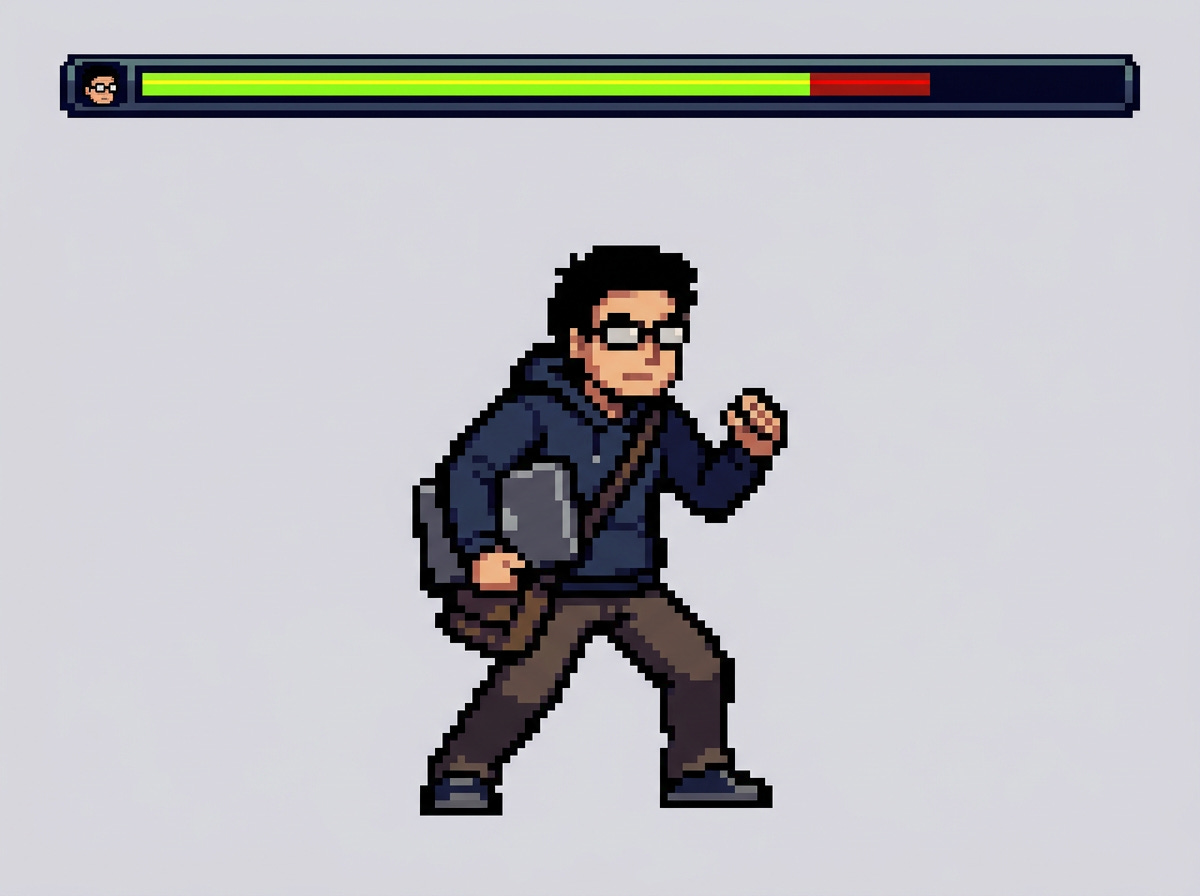
(AI-generated image)
Your power level may vary, but fortunately you can change your loadout. Like a video game where you need special armour for a mission, you can choose the best tactics to help you with your current work.
When we explored tactics earlier you might have been thinking, “great, I’ll do these all the time and be super good.” It can actually be exhausting to do all these habits all the time. Some things you might always do (like sleep), but you’ll probably find it better to become aware of what you need in the current situation and do just that.
Awareness
As you actively work to assess your current state, you’ll begin to develop awareness. You’ll spend less time zoned out, and will better know what you need or don’t need at any time. In essence, this is mindfulness.
“Mindfulness means to remember to observe how mind’s attention moves from one thing to another.”
- Bhante Vimalaramsi
This is the best definition I’ve seen of mindfulness. This doesn’t mean you have to study meditation, although meditation is one of the tactics I recommend experimenting with.
By experimenting and discovering tactics, monitoring, and checking in regularly you’ll develop many of the same skills as meditation.
Also note that when I discuss meditation, I’m sticking only to developing skills of attention and awareness. Different meditation traditions may also incorporate aspects of philosophy, spirituality, or religion. That part is up to you to navigate.
Combining Development and Operations
This article mentions the Development phase frequently. Both the pillars, Development and Operations, are closely integrated.
The tactics you refine in the Development phase aren’t useful unless you use them in the Operations phase. Some of the tactics you test in Development may even be primarily Operations-focused. Done right, it will be a cycle where one phase strengthens the other.
